How to use a foam roller, and which size to get
Slow passes over muscle, not bone, for 30 to 60 seconds on a tender spot. What rolling does is more modest than its reputation, and which roller to buy depends on how you will use it.
On this page
A foam roller is a firm foam cylinder that you lie or lean on, so your own body weight presses into a muscle while you roll slowly back and forth. The American Council on Exercise (ACE) calls this self-myofascial release, likens it to a sports massage, and describes it as part of a warm-up, a cool-down or both.
What rolling does, and what it doesn't
Some of what gets said about foam rolling is bigger than the evidence behind it. The clearest summary we found is a 2019 meta-analysis in Frontiers in Physiology that pooled 21 studies (14 of foam rollers, 7 of roller massage bars). Rolling before exercise gave a small gain in flexibility, about 4%, and a smaller one in sprint performance, about 0.7%. Rolling after exercise reduced how sore people said they felt, by about 6%. The authors judged the effects on performance and recovery to be rather minor and partly negligible, though relevant in some cases, and concluded that the evidence supports rolling as a warm-up more than as a recovery tool.
So roll because it is a useful warm-up step, or because you like how it feels. Do not roll expecting it to fix an injury. We sell rollers, and we would still rather you knew that before buying one.
How to roll
ACE's guidance, in short:
- Roll slowly, in short passes of about 5 to 15 cm (2 to 6 in).
- Stay on muscle, and keep the roller off bones and joints.
- When you find a tender spot, roll it slowly for 30 to 60 seconds.
- If you are new to it, start with 5 to 10 seconds per area and leave a day between sessions. It can feel tender, even bruised, the first few times.
- Do not roll directly on your lower back (the lumbar spine).
You control the pressure with how much of your weight goes onto the roller. Take more on your hands or the other leg to make it lighter; stack one leg on top of the other to make it heavier. ACE suggests a softer roller for anyone who has not rolled before. Both of ours are high-density foam, so the way to start gently on either is to keep more of your weight on your hands.
Where to roll
ACE's checklist covers the upper back, chest, abs, hip flexors, glutes and shoulders, and on the legs the calves, the outside of the thigh (the IT band), the inner thigh, the quads, the hamstrings and the muscle down the front of the shin. Here are six to start with, and how to get onto them:
- Calves. Sit with the roller under one calf, hands on the floor behind you, and lift your hips. Cross the other leg over the top to add weight.
- Hamstrings. The same position, with the roller moved up under the back of the thigh.
- Quads. Face down, forearms on the floor, with the roller under the front of the thighs.
- Outside of the thigh. Lie on your side with the roller under the thigh, and plant the top foot on the floor in front of you so that leg can take some of the weight.
- Glutes. Sit on the roller, cross one ankle over the other knee and lean towards the crossed side.
- Upper back. ACE says to keep the roller parallel to the spine for the upper and mid back, not across it. Lie back along the roller with your knees bent and feet on the floor, and keep it off your lower back.
When not to roll
Rolling a tight muscle is not the same as treating an injury. The UK's National Health Service (NHS) advises avoiding heat, alcohol and massage for the first couple of days after a fresh sprain or strain, and a foam roller is a form of massage. ACE suggests checking with a doctor before you start, particularly if you have a heart or vascular condition or a chronic pain condition.
Pain that does not settle is a reason to get it looked at, not a reason to roll harder. The NHS says to see a doctor if a sprain or strain is getting worse, or is not getting better after treating it yourself, and to get urgent advice if it is very painful, badly swollen or you cannot put weight on it.
Which roller, and which size
We sell two, and they differ in the ways people ask about.
| Textured foam roller | EVA foam roller | |
|---|---|---|
| Surface | Textured grid | Smooth textured |
| Material | EVA foam, high-density inner core | High-density EVA foam |
| Size | 26 x 7.5 cm or 33 x 14 cm (about 10 x 3 in or 13 x 5.5 in) | 30 cm long, 10 cm across (about 12 x 4 in) |
| Colours | Black | Four |
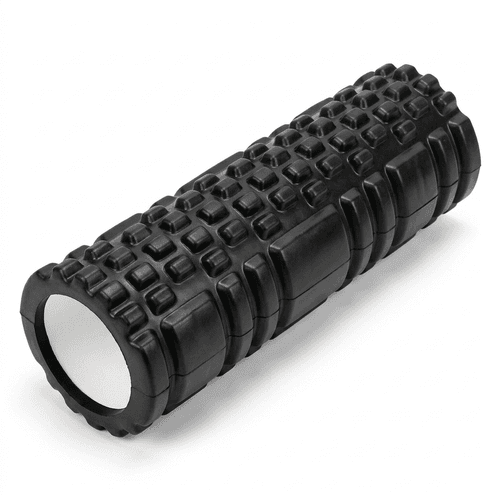
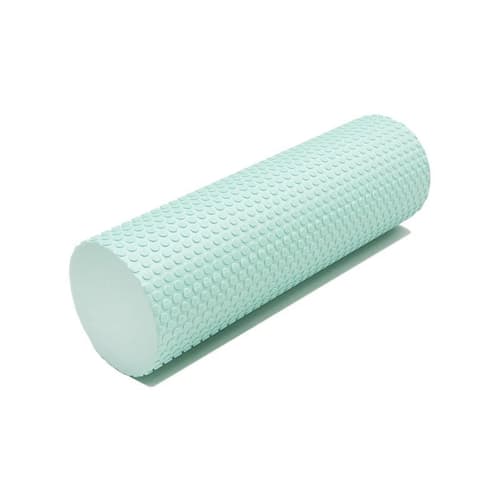
The textured foam roller is the grid one, and the EVA foam roller is the one in four colours. Three things separate them:
- Surface. The grid roller's page describes a textured grid surface; the EVA roller's page calls its surface smooth textured, and says the texture helps with grip. We found no evidence that one surface works better than the other, so treat texture as a matter of preference. Neither page gives a firmness rating beyond high-density foam (the EVA page adds "firm, consistent support"), and neither is sold as the soft option, which is why the advice above about starting light applies to both.
- Diameter. The diameter is how far the roller lifts you off the floor. The grid roller is listed as 26 x 7.5 cm and 33 x 14 cm. Taking the second figure as the diameter, the large one lifts you almost twice as high as the small one. The EVA roller sits between them at 10 cm.
- Length. A longer roller gives you more room across your body, and space to shift sideways without running off the end. A shorter one is for one area at a time, and takes up less room in a bag.
If it is your first roller and you mainly want it for your legs and upper back, the EVA roller or the large grid roller is the better fit, though neither is sold as a soft one. If you want one that travels, the small grid roller. If you already roll and know you like a grid surface, the grid roller in whichever size suits you.
Fitting it into a session
Before a session, roll the muscles you are about to use, keeping to the times above, then go on to your usual warm-up. Afterwards, go over the same areas slowly as part of cooling down. ACE's view is that rolling goes alongside stretching and should not fully replace it.
Both rollers wipe clean with a damp cloth. Let them air dry and store them somewhere cool and dry; the EVA roller's page adds out of direct sunlight. Both are in the Recover aisle, with the braces and supports.
Sources
About this guide. We sell the products named here, and we have tried to say plainly where they are not the right choice. Product details come from each product’s own page. Health and safety points follow the sources above. They are general information, not medical advice.