Choosing a baseball bat for practice: length and league rules
A practice bat and a league bat are not always the same bat. What the rules require, what our aluminum bats are and are not, how to pick a length, and what to know about the training ball.
On this page
For league games, a youth bat has to carry the certification mark its league requires, and that rule decides more than length does. For the backyard, the batting cage and tee work at home, what matters is a length the player can control. Our two aluminum bats and our training baseball are practice gear. This piece explains why, and how to pick a length.
What the league rules say
The national youth baseball organisations, including Little League, Babe Ruth and Cal Ripken, PONY and AABC, play under USA Baseball's bat standard, USABat, which took effect on 1 January 2018. The main points, from Little League's rules and USA Baseball's own pages:
- Metal and composite bats need the USA Baseball mark. In Little League's Majors division and below, and in Intermediate (50/70) and Junior League, non-wood bats must carry the USA Baseball logo; a solid one-piece wood bat does not need one. Intermediate (50/70) and Junior League also allow BBCOR-certified bats.
- The mark has to be permanent. USA Baseball says approved bats carry a permanent certification mark on the barrel, and that stickers and decals do not count. Little League adds that a bat whose mark cannot be read is taken out of the game.
- Tee ball has its own bats and balls. Certified tee ball bats are 26 in and shorter, and carry the USA Baseball mark with a line saying they are only for use with approved tee balls. Those are low-compression balls, and USA Baseball publishes the list.
- There are length and width limits. In Little League's Minor and Major divisions, a bat can be no more than 33 in long and no more than 2-5/8 in across. USA Baseball says no USABat can currently be made longer than 32 in.
- Older divisions change the rules. In Little League's Senior League, non-wood bats must be BBCOR-certified, and no bat can be more than 3 oz lighter than its length in inches, so a 33 in bat must weigh at least 30 oz.
Leagues publish their own rules, and they change: for high school play, USA Baseball's FAQ says a new USA BBCOR mark and USABat -4, -5 and -6 bats will be permitted from the 2028 season. Check your league's current rules before you buy a bat for games.
Neither of our bats' pages lists a USA Baseball (USABat) or BBCOR mark. Treat them as practice bats, for the backyard, the cage and the tee, not for league games.
Our two bats
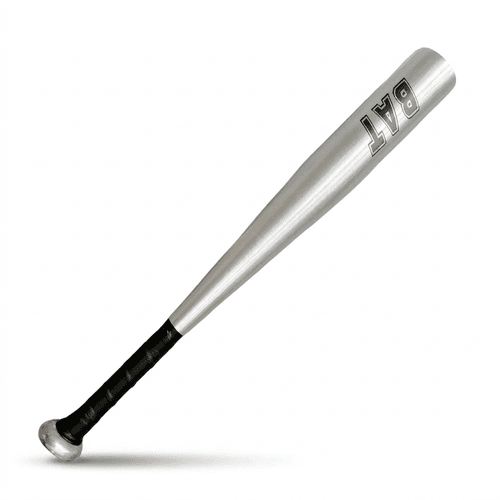
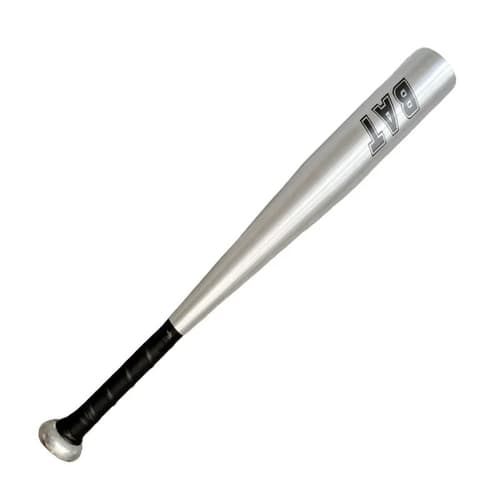
The aluminum alloy practice bat is a one-piece bat with a smooth metallic finish and a handle grip. It comes in 20 in or 30 in (about 51 or 76 cm), in silver or black.
The thickened-alloy bat is also one piece, made of thickened aluminum alloy with a non-slip grip. It comes in one length, 51 cm (about 20 in), in silver, red, blue or black.
Both pages list baseball, softball and T-ball practice. Neither lists a weight or a barrel diameter. That matters because bats are compared by their drop: the length in inches minus the weight in ounces. The high school classes coming in 2028, USABat -4, -5 and -6, are named by it. Without a weight there is no drop to quote, and we would rather say so than guess.
Which length
The rule pages we read give maximums, not a length-by-age chart. Inside those maximums, the right bat is one the player can swing under control. USA Baseball's FAQ sets out the trade-off: a lighter bat can be swung faster, a heavier one has more mass behind it, and all else being equal, players hit hardest with the heaviest bat they can manage. For a young player, the limit is control: the heaviest bat they can swing under control.
For our bats:
- 20 in, either bat. A short bat, well under the 26 in ceiling for certified tee ball bats. Neither bat's page gives a player age or height, so this is only the length to try first with a small player at a tee.
- 30 in, the aluminum alloy practice bat only. This length is within USA Baseball's 32 in maximum for a USABat and Little League's 33 in limit for Minors and Majors. Neither bat's page lists a certification mark, so that is a point about length, not about league play.
If you are unsure between the two, see what the player swings comfortably at practice. Little League notes that team managers may have team bats; a few swings with two or three lengths will tell you more than a chart would. Our own rule of thumb, not a league or USA Baseball rule: if the barrel drops, the swing slows as they go, or they have to choke a long way up the handle to control it, that length is too much bat for now.
It is worth settling before you order. Our returns policy takes back unused items in their original packaging within 30 days, and says balls and bats that have been used outdoors cannot go back.
The training ball
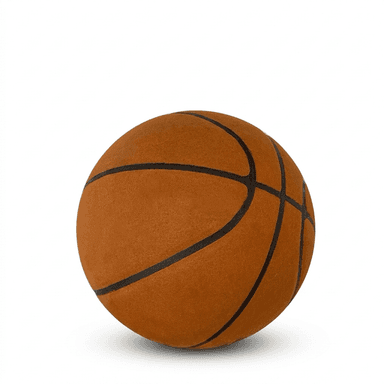
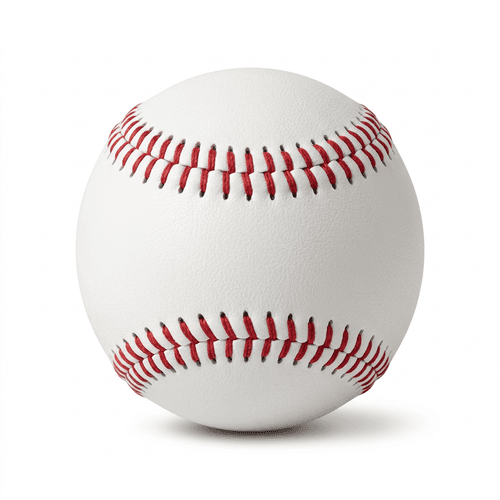
Our training baseball is white with red stitching and a synthetic leather cover, about 9 in (23 cm) around, and comes as a soft ball or a hard ball. Its page does not say how the two differ, so we will not say which suits which age. It does list standard baseball dimensions and regulation weight, with a cork core and rubber centre, for both, so do not assume the soft version is a low-compression tee ball. If you are buying for a young child, ask us before you order.
It is not on USA Baseball's approved tee ball list. Certified tee ball bats are labelled as only for use with approved tee balls, so do not use this ball with one.
Before every session
- Look the bat over. Both bats' pages say to check it for wear before each use, and Little League takes any bat with cracks or sharp edges out of play. Retire one that has them.
- Wear a batting helmet. Little League asks players to bring one to every practice, and says a helmet a player owns should be approved by NOCSAE, the National Operating Committee on Standards for Athletic Equipment.
- Clear the space around the hitter before anyone swings. That one is our own advice, not a rule from the sources above.
- Wipe the bat after use and keep it somewhere cool and dry. Both pages warn against long exposure to moisture.
The bats and the ball are in the Train aisle. The baseball tees, hoodies and crewnecks are in Represent.
Sources
About this guide. We sell the products named here, and we have tried to say plainly where they are not the right choice. Product details come from each product’s own page. Health and safety points follow the sources above. They are general information, not medical advice.